The Architecture: What the Room Is Saying
You noticed it the first time you walked in.
Maybe you couldn’t name it then — the weight of the room, the way it arranged you before anyone said a word. The ceiling higher than it needed to be. The bench elevated. The gate between you and the process. The pews filled with people who were present but not participants.
You were reading the room. You just didn’t know that’s what you were doing.
Winston Churchill once observed that we “shape our buildings, and afterwards, our buildings shape us.” (1943) He wasn’t talking about courtrooms — but he could have been. Because the courtroom didn’t arrive at its current form by accident. Every element of its design is intentional. The elevation of the bench is a statement about authority. The bar dividing process from the public is a statement about access. The sight lines between witness and jury are a statement about what the system believes truth requires.
The room is not a neutral container for justice. It is a statement about how justice works.
In part 1 of this series, we talked about walking into the middle of the story, now we are talking about how to use the clues available in the physical setting to orient us to what is happening. And how we can align ourselves to it in short order.
How the Courtroom Got to Be What It Is
American courtrooms didn’t begin this way. Justice started in taverns and town houses — public, minimal, barely enclosed. The early courthouse was essentially the courtroom itself: open space for adjudication, almost no separation between the process and the people watching it. Attorneys weren’t yet assigned their own territory. The judge’s end was distinguished mainly by a raised platform and a bar restricting physical access.
Over time, the room acquired a purpose. Purpose-built structures replaced taverns. Commerce was separated from justice. Buildings modeled after English courthouses encoded hierarchy through design: dedicated rooms for jury deliberation, administrative spaces, private meeting areas for attorneys and clients.. The clerk moved closer to the judge. Counsel was separated from the public. The jury was enclosed and angled to maximize sight lines. A second bar divided the adjudicative space from spectator seating.
Every redesign added territory, hierarchy, and meaning. What you walk into today is not an accident of construction — it is a century of accumulated meaning about who belongs where, and why (see Spaulding, 2012) & Mulcahy, 2007).
What the Architecture Is Communicating
Power
Before you hear a word of testimony, the room has already told you something about authority. The imposing proportions, the grand staircase, the elevated bench — these are not aesthetic choices. They are instructions. The building commands deference before anyone speaks. The architecture itself performs solemnity.
Mulcahy (2007) frames courtroom design as a struggle for territory — space is claimed and assigned, and those assignments encode value judgments about who holds power and who is subject to it.
Process
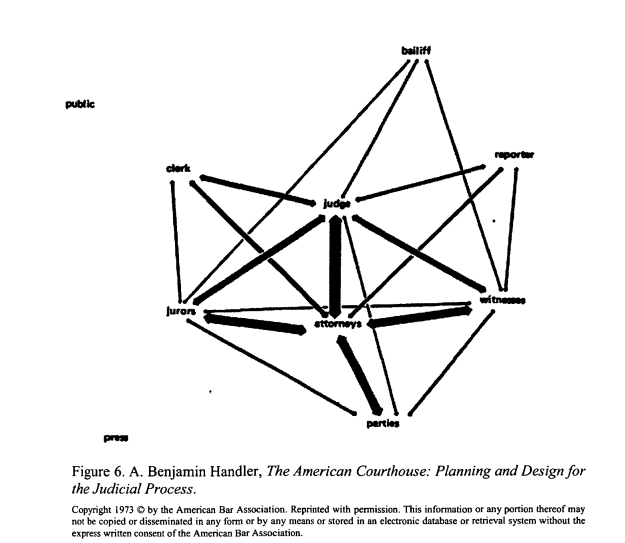
The spatial organization of the adversarial system is not incidental to the process — it is the process, made physical. The room was designed to ensure proximity, audibility, and clear sight lines specifically to stage adversarial confrontation: direct testimony, cross-examination, the right to face one’s accuser.
Look at the Handler diagram below — it maps every relational line in the courtroom: judge to jurors, attorneys to witnesses, bailiff to parties, press to public. The room encodes every one of those relationships spatially. Different heights, different angles, different distances — all of them assigned on purpose.
Justice Must Be Seen
In 1923, Lord Chief Justice Hewart ruled in R v Sussex Justices that ‘justice should not only be done, but should manifestly and undoubtedly be seen to be done.’
The courtroom architecture answers this demand structurally. Elevated witness boxes, open galleries, unobstructed sight lines — these are not design flourishes. They are the physical expression of a legal principle. Justice must be visible to be legitimate.
For most people in that room, this is a legal principle. For the interpreter, it is a job description.
So What Does This Mean for Interpreters?
Our job is to align with the setting, its goals, and its functions. That starts with understanding what the room is trying to do — and why.
The courtroom was designed around the principle that justice requires visibility: witnesses seen and evaluated, testimony heard and assessed, process witnessed by all parties. That principle doesn’t just apply to attorneys and judges. It applies to the interpreter, too.
Alignment: Understanding the Room’s Values
The hierarchical structure of the room is not simply about power for its own sake — it reflects the fact that different people have different jobs. The judge, the jury, the attorneys, the court reporter, the witness — each occupies a distinct territory because each role has a distinct function. The interpreter’s job is to understand that map and know where we fit on it.
Deference to structure — both physical and procedural — is not passivity. It is professional alignment. Knowing when not to move, when not to ask for a repeat, when not to interrupt a sight line is as much a professional skill as knowing when to do those things.
RID Code of Professional Conduct Tenet 3 speaks directly to this: interpreters conduct themselves in a manner appropriate to the specific interpreting situation. Tenet 3.4 goes further — comply with established workplace codes of conduct, and seek resolution when conflicts arise. You can’t do either without first understanding how the space itself encodes the rules of conduct. The architecture is part of the workplace code.
In order to do so, we must be able to identify where and when those type of conflicts may arise, for example with sight lines.
The Deaf Juror Example
Consider what happens when there is a Deaf juror. The accused has a right to fair consideration by all jurors — which means each juror, including the Deaf one, needs full access to witness testimony in order to assess credibility and weigh its trustworthiness. The interpreter is now physically positioned inside a sight line that the room didn’t originally design for.
What are the considerations? Where do you position so the juror can see both you and the witness? What does your positioning communicate to the other jurors? What does it communicate about the witness? How do you preserve the witness’s ability to be evaluated — their affect, their directness, their hesitations — while also delivering the content to the juror who needs it?
That is not a logistics question. That is a question about professional values in a designed environment. The room was built with specific sight lines in mind. Your job is to work within them, not around them.
The Deaf Defendant Example
Consider a Deaf defendant that has a right to face their accusers and confront any witnesses against them, as well as aid in their own defense in assisting their attorney. The interpreter needs to be positioned in such a way as to allow access to content and the original source (witness) behavior/mannerisms, etc, while also allow private access to their attorney (if there is no table interpreter present).
This also needs to be accomplished while also not blocking any sight lines for attorneys, jurors, or judges… this can sometimes be tricky to accomplish in some coutrooms, particularly older ones that were not designed with interpreting needs in mind.
The Deaf Witness and Deaf Defendant Example
This will be similar in ideas to the other 2 examples but has yet a different angle with the idea of not blocking sight lines and access for jurors, judges, attorneys and the defendant themselves. But now we have the need for visual access between the defendant and the witness to be able to see the testimony given in ASL.
This is where the CPC tenet 3 comes in and where creativity and communication is warranted. There may need to be some open communication and negotiation with the various parties at play to accomplish the goals. In my experience, we’ve had testimony from non-traditional locations (like not in the witness box), or parties moved to other tables and or parts of the gallery to be able to see. When all parties understand that the goal is access to justice, not accommodation of inconvenience, the negotiations tend to find their way.
Practical Considerations: Reading the Room Before and During
| Before You Walk In → Find out the physical layout in advance if possible — where will you be placed, and does that placement support the sight lines the room requires?→ In virtual settings, ask the same questions: camera angle, lighting, background framing. These are credibility variables the room used to handle automatically. → Know whether there is a jury and where they will be seated in relation to where you’ll be working. |
| When You Arrive → Assess your sight lines — to your consumers, and from the jury to the witness. → Identify the attorney-client space and respect it. That separation is not etiquette; it is a constitutionally grounded right. Oftentimes this needs to also be protected in unique ways given we use a visual language – are there other signers in the vicinity who could “oversee” the conversations between attorney and client, make that known so it can be protected. → Find the court reporter and or become aware of mics and what will pick you up when interpreting in to spoken language. Your clarity — volume, pacing, articulation — directly affects the record. |
| During the Proceeding → Your affect is visible. The room was designed so that everything is visible. Behave accordingly. → Understand what is and isn’t evidence, and how that shapes what you do. Not everything spoken in the room carries the same weight or is handled the same way. → Deference to structure is active, not passive — it requires you to read the room continuously, not just once when you walk in. |
The Room Has Already Spoken
Before testimony begins. Before counsel rises. Before the judge takes the bench. The room has already made its argument about power, process, and the visibility of justice.
The interpreter who walks in — or logs in — without reading that argument is arriving on page 47 in a different way than the one we talked about last time. Not missing backstory. Missing the architecture of the story itself.
Read the room. It’s been speaking the whole time.
References
Churchill, W. (1943, October 28). Hansard, 393, col. 403. House of Commons: Rebuilding of the House of Commons. https://api.parliament.uk/historic-hansard/commons/1943/oct/28/rebuilding-of-the-house-of-commons
Mulcahy, L. (2007). Architects of justice: The politics of courtroom design. Social & Legal Studies, 16(3), 383-403.
Registry of Interpreters for the Deaf. (2024). Code of professional conduct. https://rid.org/programs/ethics/code-of-professional-conduct/
R v Sussex Justices, ex parte McCarthy, [1924] 1 KB 256 (King’s Bench Div. 1923).
Spaulding, N. W. (2012). The enclosure of justice: Courthouse architecture, due process, and the dead metaphor of trial. Yale JL & Human., 24, 311.
 Amanda's Musings
Leave a comment